
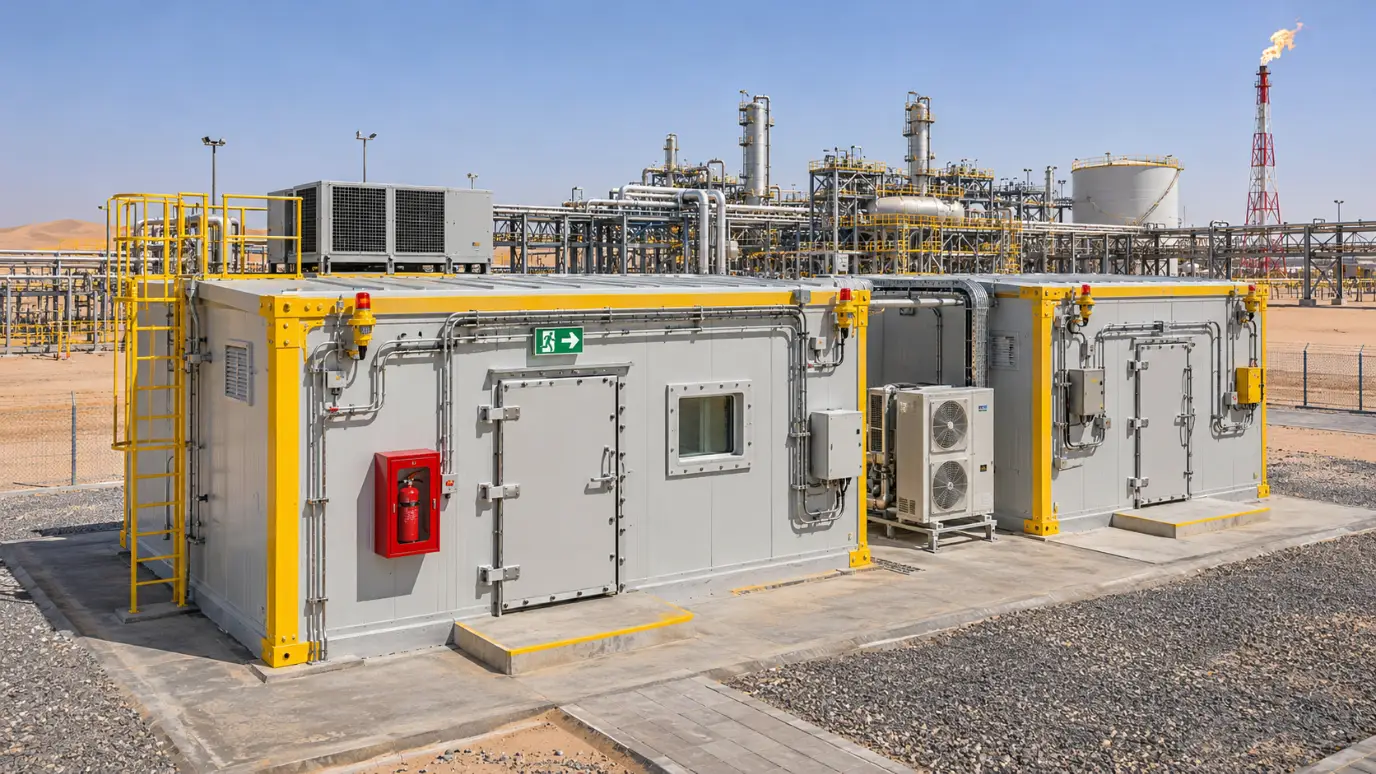
Oil and gas modular buildings are prefabricated structures engineered to industrial codes to protect workers and critical equipment against explosions, fires, hazardous gas leaks, corrosion, and extreme weather. Even a minor safety failure in these facilities can put workers’ lives, critical equipment, and entire operations at risk.
Therefore, oil and gas modular buildings are designed to meet strict safety measures, including blast resistance, fire protection, hazardous-area electrical systems, ventilation, and corrosion-resistant materials. Read on to explore the key safety requirements, industry standards, and testing procedures for these modules.
What Are Modular Oil and Gas Buildings?
Modular oil and gas buildings are prefabricated structures manufactured off-site in sections, then transported and assembled where they are needed. They are engineered to meet industrial codes rather than ordinary commercial standards, which sets them apart from the general-purpose units covered in our guide to where modular buildings are used across UAE industries.
What Types of Modular Buildings Are Used in Oil and Gas?
The oil and gas industry relies on several standard module types, each with its own safety priorities. The most common types are outlined below.
Modular Control Rooms
These are centralized spaces where operators monitor operations and manage equipment. Because they are often occupied around the clock near process areas, they usually need blast and fire protection.
Modular Electrical Rooms
Also known as E-houses, these modules house electrical equipment, including switchgear, motor control centers, and transformers.
Modular Site Offices
Modular site offices support supervisors, engineers, and contractors. They are lighter in construction but still need durable finishes, safe exits, and weather protection.
Modular Accommodation Units
Workforce accommodation for remote locations must provide insulation, fire detection, safe egress, and comfortable climate control for long rotations. On larger projects, these units are often delivered as complete turnkey camps.
Modular Blast-Resistant Buildings
These are heavily engineered modules that protect people and equipment close to process areas.
What Is a Blast-Resistant Modular Building (BRM)?
A blast-resistant modular building (BRM) is engineered to withstand a specified explosion overpressure resulting from potential blast hazards such as vapour cloud explosions (VCEs), hydrocarbon gas explosions, and accidental releases of flammable substances. Here are the specially engineered elements that make this possible.
Blast Pressure Considerations
Engineers conduct a facility-specific risk assessment before deciding how much blast pressure a modular building must withstand. They examine several factors, including process equipment, hazardous substances, and potential explosion scenarios.
Once they identify the potential risks, they use industry guidelines such as API RP 752 (for permanent buildings), API RP 753 (for portable buildings), ASCE blast design guidance, and similar standards. These help define acceptable damage and occupant-safety criteria.
Reinforced Structural Systems
Blast-resistant modules are built on a heavy-duty structural steel frame that forms the main load-bearing skeleton, so the building can withstand high-pressure blast loads without collapsing. This structure transfers blast forces from the walls and roof to the supporting foundation while maintaining stability.
Blast-Resistant Doors and Windows
Blast-resistant modular buildings feature specially engineered doors with heavy steel panels, robust hinges, latches, and a multi-point locking mechanism. These doors and the matching blast-rated windows can withstand sudden pressure changes without becoming detached or creating dangerous debris.
What Fire Safety Requirements Should Be Considered?
Fire safety is one of the most important considerations in oil and gas modular buildings. These facilities handle flammable gases, hydrocarbons, fuels, and other combustible materials that can cause fires, flash fires, or explosions if accidentally released and ignited. Where such materials must be stored on site, purpose-built steel bunkers for oil and gas keep them contained. Here are the key fire safety requirements to consider.
Fire-Rated Materials
The structural stability of modular buildings is crucial, especially where they are exposed to high temperatures. Engineers use fire-protective coatings, insulated panels, non-combustible mineral wool insulation, and properly tested wall assemblies to slow heat transfer and reduce the risk of structural failure during a fire.
Fire and Gas Detection
Fire and gas detection systems identify signs of fire and gas leaks, then alert occupants and facility operators so they can start emergency procedures. From aspirating smoke detection (ASD) to optical flame detectors and combustible and toxic gas detectors, engineers integrate suitable technologies based on the building’s function and operating environment.
Emergency Exits
Emergency exits and evacuation routes give occupants safe escape paths during a fire. Modular buildings should include clearly marked exits, emergency lighting, accessible corridors, and suitable exit doors. Properly planned escape routes help personnel evacuate quickly while avoiding hazardous areas.
Fire Suppression Systems
Fire suppression systems, including wet and dry pipe sprinklers, dry chemical systems, and foam, help control or extinguish fires before they spread and damage critical equipment or threaten occupants.
Which Materials Are Suitable for Harsh Environments?
Oilfield sites expose modular buildings to salt, chemicals, sand, ultraviolet radiation, and temperature swings from desert heat to Arctic cold. Engineers therefore select materials based on the building’s location, exposure risks, and intended use. The following options are widely used.
Corrosion-Resistant Steel
Its resistance to rust and corrosion makes stainless steel a reliable choice for fasteners, fittings, equipment supports, and components exposed to moisture or chemicals.
Insulated Wall Systems
Wall systems are made from sandwich panels of galvanised steel or aluminium sheets with an insulated core of mineral wool, rock wool, PIR (polyisocyanurate), or polyurethane foam.
Heavy-Duty Flooring
Steel, aluminium, reinforced concrete, vinyl, rubber, or fibre-reinforced polymer (FRP) grating gives the floors of modular buildings strength, durability, corrosion resistance, and slip resistance.
Weather-Resistant Coatings
Epoxy, polyurethane, zinc-rich primer, and specialised industrial coatings help protect metal surfaces against corrosion, chemicals, abrasion, and weather exposure.
What Electrical and Ventilation Systems Are Required?
Building services are among the most safety-critical parts of the design.
Hazardous-Area Electrical Systems
In potentially explosive atmospheres, the electrical equipment of a modular building must be certified for the area classification, such as ATEX, IECEx, or NEC/CEC Class and Division ratings. Correct cable glands, sealed conduits, and proper earthing prevent ignition sources.
Emergency Power
Backup power systems, including UPS units, generators, and batteries, keep alarms, emergency lighting, communication, and control systems running during an outage. Battery rooms need their own ventilation and protection.
Ventilation and Filtration
In oil and gas modular buildings, ventilation systems must prevent hazardous gases, fumes, and contaminants from accumulating. Engineers select suitable air-handling units, exhaust fans, filters, and ductwork according to occupancy and process-related risks.
Temperature Control
Oil and gas modular buildings commonly use HVAC units, air conditioners, chillers, electric heaters, thermostats, and temperature sensors to regulate indoor conditions. The right HVAC system keeps electronics within operating limits and occupants comfortable.
How Are Oil and Gas Modules Inspected?
Effective inspection is essential for oil and gas modular buildings. It is carried out during fabrication, before transportation, after installation, and throughout the building’s operational life.
Material inspection: Confirm that steel sections, insulation, fasteners, cables, and other materials match approved drawings, specifications, and material certificates.
Welding inspection: Examine welded joints for cracks, incomplete fusion, porosity, and other defects. Visual inspection and non-destructive testing (NDT) may be used where required.
Electrical testing: Qualified electrical personnel identify faults that could cause electric shocks, equipment failures, overheating, or ignition in potentially explosive environments.
Factory acceptance testing (FAT): The client witnesses the module’s operational testing. Detection, alarms, HVAC, and power systems are verified, and any defects are corrected before shipping.
How Are Modular Buildings Delivered to Remote Sites?
Delivery is a project phase of its own and needs careful planning.
Transportation Planning
Planners review route restrictions, bridge limits, permits, escorts, and weather windows. Module dimensions and weight are designed to fit road, rail, or sea transport as applicable.
Lifting and Crane Requirements
Certified lifting lugs, spreader beams, and a documented lift plan are essential. Crane capacity, ground conditions, and wind limits must be confirmed in advance.
Site Installation
Modules are placed on prepared foundations or piers, then levelled, anchored, and connected. Utility, cable, and data connections are completed using pre-planned interfaces to reduce on-site work, as explained on our modular building installation and offsite delivery page.
Testing and Commissioning
After installation, teams repeat key tests, verify integration with plant systems, and train operators. Documentation handover completes the process.
Conclusion
Safe oil and gas modular buildings depend on thorough risk assessments, durable materials, reliable safety systems, and comprehensive testing. Working with an experienced manufacturer and confirming compliance with applicable local codes and standards helps ensure the finished module protects people, equipment, and operations for years to come. Off-site manufacturing also shortens schedules, as our article on how modular construction reduces project time and cost explains.
At Accent UAE, we deliver high-quality, purpose-built modular buildings for oil and gas environments. Whether you need modular control rooms, equipment enclosures, electrical buildings, or accommodation facilities, we provide engineered solutions that support uninterrupted operations. Contact our team to discuss your project requirements.
FAQs
What is a blast-resistant building?
It is a structure engineered to withstand a specified explosion overpressure and protect the people and equipment inside, based on a site-specific blast study.
Can modular buildings be used in hazardous areas?
Yes, provided they are designed for the area classification, with certified electrical equipment, pressurization, and gas-tight construction.
Which materials are best for oilfield buildings?
Coated or galvanized steel, insulated fire-rated panels, and chemical-resistant flooring perform best. The right choice depends on the corrosion and climate conditions at the site.
Can oil and gas modules be relocated?
Yes. Modules designed with skids, lifting points, and standard connections can be moved and reused, subject to structural checks before each relocation.
Are modular units suitable for offshore projects?
Yes, when designed to offshore requirements for weight, corrosion resistance, fire protection, and lifting, and certified to the relevant marine and platform standards. Accent also builds marine and offshore accommodation modules for these projects.