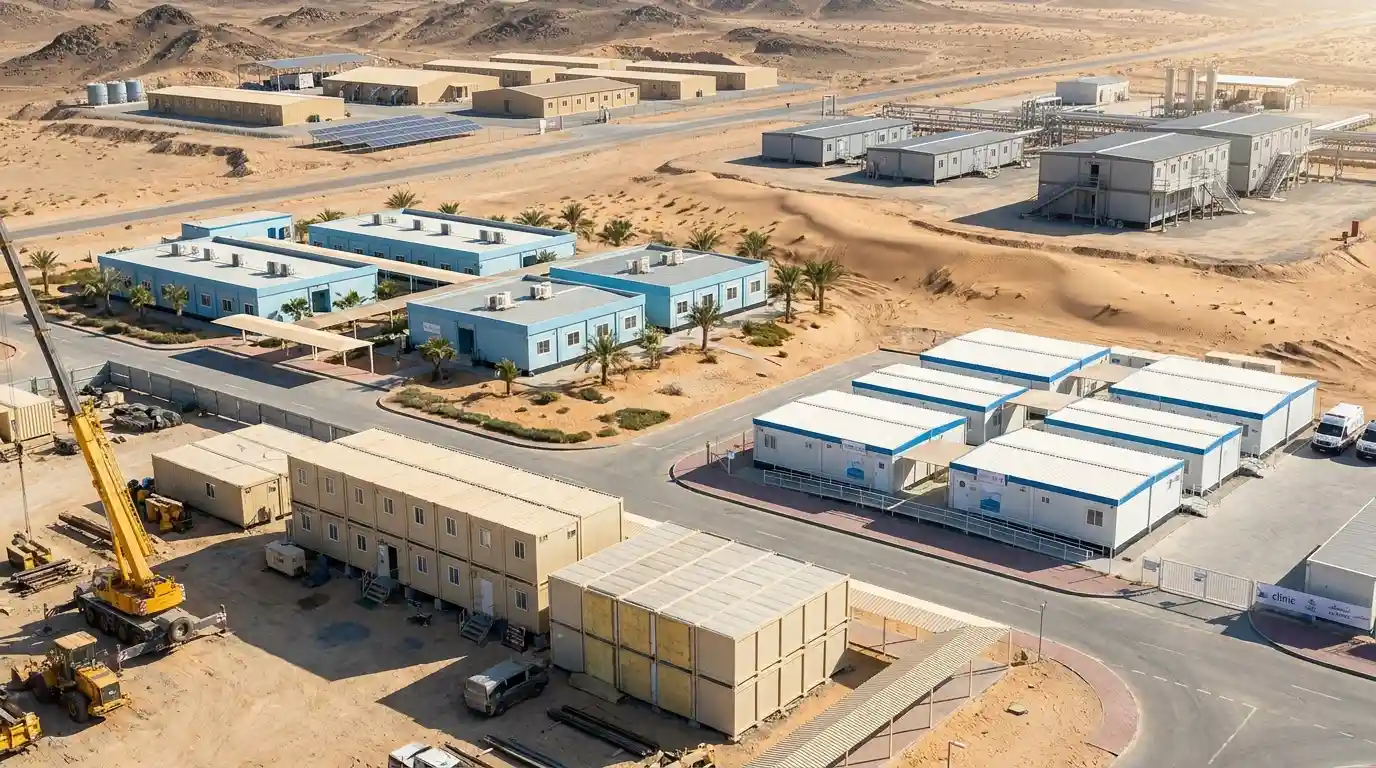
From construction site offices to educational facilities, from remote workforce camps to temporary clinics, modular buildings have become a popular choice for industrial projects where speed, cost, and compliance matter.
The UAE’s modular construction sector is expected to grow from AED 22.68 billion to approximately AED 34.28 billion by 2029, highlighting the growing demand for sustainable yet affordable, modular solutions across the UAE.
In this comprehensive guide, you’ll explore the different applications of modular buildings across UAE industries and how these structures support various projects.
How Modular Buildings Revolutionize UAE’s Industries?
Modular buildings work as a game-changer for business projects that are in search of faster, yet high-quality and sustainable building solutions for their projects. Here’s how the application of modular buildings drives efficiency, productivity, and profitability in the industries.
- Improve Productivity and Efficiency: Modular buildings provide functional spaces faster, helping teams focus on work and maintain smoother operations.
- Effective Budget Management: Shorter construction periods, controlled manufacturing, and reduced waste help businesses manage project budgets more effectively.
- Easy Expansion, Relocation, and Reconfiguration: Modular units can be expanded, relocated, or reconfigured as workforce numbers and project requirements change.
- Faster Construction Timelines: Off-site manufacturing and ready-to-install modules reduce construction time, allowing businesses to start operations sooner.
- Built-In Quality and Compliance: Controlled manufacturing supports consistent quality while accommodating relevant safety, structural, electrical, and regulatory requirements.
What Are The Applications of Modular Buildings in Construction?
In the construction industry, modular buildings bring flexibility by creating site offices, meeting rooms, worker accommodation, and storage areas.
1. Site Offices
Construction companies use modular site offices to create practical workspaces for project managers and supervisors, allowing them to oversee activities efficiently while staying close to the construction site.
2. Meeting Rooms
Modular meeting rooms fulfill the regular needs of construction teams for project meetings, safety briefings, contractor discussions, and client presentations without requiring permanent construction at the site.
3. Worker Accommodation
For large-scale construction projects, modular accommodation provides workers with convenient living spaces near the worksite, especially in remote areas.
4. Storage Facilities
Modular units act as a storage area at the construction site to store tools, construction materials, documents, spare parts, and equipment, eliminating the need for permanent warehouses.
What Are The Applications of Modular Buildings in Education?
As schools and educational facilities expand, portable building applications provide a practical way to create additional classrooms, laboratories, administrative offices, and activity spaces.
1. Modular Classrooms
Modular classrooms in the UAE help educational institutions quickly and affordably add spaces to accommodate a growing number of students without lengthy conventional construction.
2. School Administration Buildings
Due to construction and budget constraints, schools often use prefabricated units to create reception areas, staff offices, admissions departments, and other administrative spaces.
3. Laboratories and Activity Rooms
Among the various uses of modular buildings in educational facilities, one key application is creating science laboratories, computer rooms, art spaces, libraries, and activity rooms.
What Are the Applications of Modular Buildings in Healthcare?
Healthcare sectors in the UAE use modular healthcare buildings for temporary clinics, additional patient rooms, medical diagnostic labs, and staff spaces during expansion, renovation, or pandemic situations.
1. Temporary Clinics
Healthcare providers use modular clinics when they need additional consultation and treatment spaces, when existing facilities are overcrowded or under renovation.
2. Medical Testing Facilities
For temporary healthcare projects, screening programs, or expansion requirements, modular buildings serve as a dedicated space for medical testing and diagnostic services.
3. Patient Rooms
When hospitals need extra space for patients, modular patient rooms allow healthcare facilities to accommodate more patients without disrupting their regular services.
4. Staff Facilities
Modular healthcare buildings create dedicated staff offices, changing rooms, rest areas, and meeting spaces to keep staff-related activities separate from patient areas.
How Are Modular Buildings Used in Oil and Gas Industries?
Oil and gas companies in the UAE are adopting modular building applications to meet the needs of HSE teams, field engineers, and workers for smooth project operations.
1. HSE Supervisor Station
Industrial modular buildings give Health, Safety, and Environment (HSE) teams at project sites a dedicated space for conducting inspections, maintaining safety records, and coordinating emergency procedures.
2. Field Engineer Offices
This modular structure provides field engineers with a dedicated workspace for project planning, technical discussions, documentation, site monitoring, and coordination with other teams.
3. Worker Accommodation Camps
When oil and gas projects operate in remote locations without permanent housing, modular accommodation camps provide workers with convenient and functional living facilities, close to the worksite.
4. Modular Equipment Storage
Modular equipment storage buildings provide secure and organized spaces for storing tools, spare parts, electrical equipment, machinery, and other project materials.
What Are the Uses of Modular Buildings in Commercial Projects?
Across the major cities of the UAE, including Dubai, Abu Dhabi, and Sharjah, the application of modular commercial buildings is increasing to create temporary offices, retail units, restaurants, cafes, and event spaces.
1. Modular Offices
Businesses are adapting modular offices for additional departments, temporary project teams, branch operations, or workspace expansion, which can be expanded or reconfigured as teams grow.
2. Retail Units
Retailers can use modular buildings for shops, kiosks, sales offices, and showrooms, benefiting from faster installation, customizable layouts, and better control over construction costs.
3. Restaurants and Cafes
Several commercial projects use modular restaurants and cafes to add a customizable food and beverage spot at the construction site that can be installed faster than conventional buildings.
4. Modular Event Spaces
Commercial projects in the UAE often use modular buildings to create temporary or semi-permanent venues for events, exhibitions, conferences, product launches, and other gatherings.
What Are The Applications of Modular Buildings for Workforce?
Across the UAE, industries use modular buildings to provide employees with comfortable accommodation close to their workplaces, helping improve productivity, worker wellbeing, and overall project continuity.
1. Sleeping Units
Modular sleeping units are individual rooms or shared accommodation for workers, staff, supervisors, technicians, and project teams with beds, proper ventilation, insulation, lighting, air conditioning, and secure storage.
2. Dining Facilities
Modular dining halls give workers a comfortable and hygienic place to have meals without travelling far from their accommodation or worksite. Depending on workforce needs, they can include kitchens, seating areas, washing facilities, and food preparation zones.
3. Recreation Facilities
Recreation rooms provide workers with spaces to relax outside working hours. Depending on the project’s scope, adding prefab recreation units may include common rooms, indoor activity areas, television rooms, or other leisure spaces.
4. Modular Ablution Blocks
Modular ablution blocks can provide dedicated shower, toilet, and washing facilities. They can be configured according to workforce size and connected to the necessary water, drainage, and electrical systems.
How Are Modular Buildings Used in Remote Locations?
Some UAE projects are located far from established commercial or residential areas. Building conventional facilities in these locations can be difficult, particularly when projects are temporary or require rapid deployment.
1. Desert Projects
Desert construction and infrastructure projects may need offices, accommodation, storage, security facilities, and welfare spaces. Modular buildings can provide these facilities while reducing the need for extensive conventional construction at isolated sites.
2. Industrial Facilities
Industrial projects can use modular structures for offices, workshops, storage rooms, control facilities, staff areas, and other operational spaces. The building specifications can be selected according to the environment and intended use.
3. Marine and Coastal Sites
Ports, coastal developments, marine projects, and waterfront construction sites may require temporary offices, worker facilities, storage areas, and security rooms. Modular structures can be configured for these project-specific needs.
4. Infrastructure Projects
Roads, railways, utilities, and other infrastructure projects often move across different locations. Modular buildings can support these projects with site offices, accommodation, meeting rooms, storage facilities, and welfare spaces that can be adapted as the project progresses.
Conclusion
As modular buildings become increasingly common across the UAE, Accent offers high-standard modular building solutions specifically designed to withstand the UAE climate. We aim to help businesses create functional spaces that suit their operational needs, project timelines, and site conditions while providing the flexibility to adapt as requirements change.
Frequently Asked Questions
Can modular buildings be used permanently?
Yes. Modular buildings can serve as long-term or permanent facilities when they are designed with suitable structural, insulation, electrical, plumbing, fire safety, and regulatory specifications for their intended use.
Can modular buildings be relocated?
Many modular buildings are designed with relocation in mind. Depending on their construction and foundation requirements, units can be dismantled, transported, and reassembled at another suitable project location.
Are modular buildings suitable for remote sites?
Yes. Modular buildings are particularly useful for remote sites because they can provide offices, accommodation, storage, and welfare facilities where conventional construction may be slower or more difficult.